Monday, February 23, 2026

What I'm Doing Here

I've been building Beneath Ahknoor for a while now—long enough to know what it is, and why it matters to me. This is the post I should have written first. The one that explains what I'm after, and why I'm building it this way.

I don't think there's one true way to play. I don't think you have to give one style up to learn the other. I think the best tools travel. 

OSR gives us teeth: spatial danger, real stakes, the chance to outthink the dice. Narrative play gives us intimacy: collaboration, compression, the dungeon made personal.

Beneath Ahknoor lives where those streams cross.

A megadungeon that does not reset. A place that remembers you. A game where consequences range from Complications, to Conditions, to Scars... and every descent teaches you something dreadful:

Delving makes you monstrous.

Not because the rules say so. Because you helped say how. You stare into the depths. And you see yourself staring back out.

That's what I'm building.

If you want to follow along as Beneath Ahknoor sharpens from playtest into release, the work lives on Patreon. And if you want the PDFs, the delves, and the tools in your hands, you can find them on itch.io.

The stone has been thinking.

Come back when you're ready.

Saturday, February 14, 2026

Beneath Ahknoor - Location Flashbacks

This morning, I'm working on the next piece of my 0.5 -> 0.6 development of Beneath Ahknoor, Location Flashbacks. From the rules:

There are places beneath Ahknoor that do not reset.

You leave. You return. The stone has been thinking.

A Location Flashback is not a memory.

It is not lore.

It is not an answer.

It is the dungeon’s marginalia: a brief, wrong annotation in the margin of the place you thought you knew.

Flashbacks exist to do one thing: Make the location feel continuous, personal, and costly.

The Underworld does not explain itself. It edits.

To give you the shape of it, a Flashback might sound like:

Keeper: “What detail makes you realize the dungeon expected you back?”

Player: “Our old chalk mark is still there… but it’s been neatly underlined. This place isn’t random. It’s been paying attention.” 

Next up is a deep pass on the existing levels (The Plundered Catacombs, The Warrens of the Beastfolk, The Buried Library) and the new ones I’m building (The Sunless Market, The Labyrinth of the Great Beast), adding Flashback prompts and fresh Trappings.

Sketch of a broken down, massive wheel atop the stone doorway to a dungeon


Little steps. Every day.

Saturday, February 7, 2026

When I started writing Beneath Ahknoor I had a bunch of goals in mind. I wanted to recreate the feel of delving through a massive megadungeon, trying to make sense of it. I also wanted to explore human-centric, Swords and Sorcery themes. The more I wrote, the clearer one thing became. I wanted to show how adventuring was a path of corruption and erosion.


Each time I was faced with a design choice, I felt pulled toward ideas of loss and change. It changed the game, made it clearer and more compelling. Now, it stands firmly as a megadungeon that changes adventurers, forcing them to confront not just the dungeon, but what they’re willing to become in pursuit of fame and treasure.

I’ve been hard at work on my rewrite, and 0.6, covering the core systems, is almost ready to share. After that, I’ll turn to 0.7, which really leans into corruption, and 0.8, providing Player and Keeper support. Over the next couple of months, I’ll be sharing more about 0.6 and what it means for adventurers.

Here are some of the ways the game has already changed:

  • Above Ground Phase: No longer a reset button. It now follows the arc of Returning, Reflecting, and Preparing. Moves now strain relationships with the nearby town, reveal the cost of delving, and load the next delve.
  • Retainer system: A Delving Move that provides tactical advantage that brings pressure to the Adventurers, and an Above Ground Move that mirrors the erosion of the PCs. (I've written about this on Patreon.)
  • Saga system: Introduces dungeon levels through the unreliable narrator of legends heard by the Adventurers. (I've posted about this on Patreon too.)

I’ll be writing monthly posts here, highlighting the kinds of changes that I’m making. Follow along, share your thoughts, let me know what resonates, and what surprises you. For even deeper dives, sneak peaks, and more frequent posts, check out my
Patreon.


Wednesday, February 4, 2026

Beneath Ahknoor - Adding Trappings

 Beneath Ahknoor is a Carved from Brindlewood game about old-school megadungeon exploration. Each dungeon level is treated as a mystery. Adventurers move through Locations and confront Threats to gather Clues about who controls the level, what they want, and how they might be confronted, bargained with, or endured.

The listed Locations on a level are meant to be highlights, not an exhaustive map. In play, characters will pass through plenty of unnamed passages, chambers, and transitional spaces. As a result, Keepers will be improvising side locations regularly.

I originally leaned on the CfB concept of Moments to support that improvisation. More recently, Justin Alexander’s discussion of Corridor Themes helped clarify what was missing. I wanted something lighter weight, something that could be recombined on the fly without stopping play.

The result is Trappings.

Trappings on the Level Sheet

I am adding Trappings to each Level Sheet, along with a short explanation in the rules. Here is the current text from the “Reading a Level Sheet” section:

Trappings: A list of six details that can be used to describe passages and other unnamed locations on that level. During each Exploration Move, the Keeper should select one or two Trappings to create a more engaging description of the spaces the Adventurers pass through or investigate.

Trappings are not events. They do not demand action. They exist to ground improvisation in the specific texture of the level.

Example: The Warrens of the Beastfolk

Here are the Trappings and Moments from the Warrens of the Beastfolk.

Trappings

  • Bits of cloth and fur bunched into a makeshift sleeping area

  • A narrow space that must be passed single file, moving sideways

  • Graffiti claiming the space in the name of one faction

  • A foul stench whose source is not immediately apparent

  • A broken weapon

  • Bones cracked open to get at the marrow within

Moments

  • Ankle-deep fetid water covers the floor. The sound of splashing footsteps carries through the narrow, low-ceilinged passage.

  • Rotting beams sag overhead, groaning under the weight of stone.

  • Choking smoke suddenly fills the passageway.

  • A chimeric humanoid body lies on the floor, its mismatched limbs bent at unnatural angles. The severed head is missing.

  • Hand-sized maggots crawl among the discarded remains of several beastfolk.

  • Webs with strands as thick as a finger festoon the walls, making the way forward precarious.

These tools are complementary. Moments are specific and volatile. Trappings are reusable and ambient. A Keeper can easily build new Moments by combining Trappings, or simply pick one or two Trappings to dress an unlisted location as the Adventurers move through it, investigate it, or search it for Clues.

In Play

For example, after Berend and Yasoon fail an Exploration Move, the Keeper might say:

“As you move toward what you think is the Low Gallery, you find yourself at a three-way intersection, unsure how you got turned around. In a small niche, you spot a person-sized nest made from skins and fur, mixed with what looks like a pair of old trousers and a torn adventurer’s cloak.”

No map needed. No prewritten room required. The level still feels coherent, claimed, and alive.

That is the goal here. Trappings help Keepers improvise confidently while reinforcing the identity of the dungeon level and the pressures it puts on those who move through it.

Tuesday, February 3, 2026

Beneath Ahknoor - Early Playtesting

Earlier this spring, I ran a short, limited playtest of Beneath Ahknoor during my lunch hour on weeks when our group wasn’t playing something else.

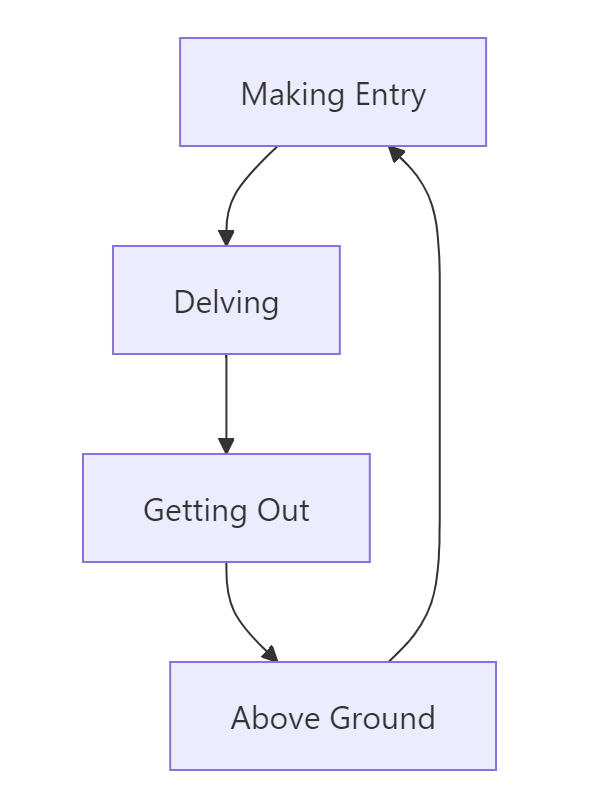
In our first session, we handled Character Generation, Making Entry, and a short stretch of Delving, two of the game’s four phases. The following session wrapped up Delving and carried us through Getting Out and Above Ground, completing the loop.

A flow chart showing the four phases of play. They start with Making Entry, which leads to Delving, which leads to Getting Out, which leads to Above Ground, which loops back to Making Entry


Character Generation

Character creation follows a familiar Carved from Brindlewood cadence, but with a clear nod toward OSR priorities. Starting position matters. The world is dangerous. The dungeon will change you.

After naming and describing their adventurer, each player allocates 3 points among their attributes. From there, they choose a starting location, the place that set their baseline expectations about safety, community, and scale.

For example:

Harjet’s Ford

Description: A backwoods village on the northern frontier, Harjet’s Ford is a gathering place for trappers, hunters, and peddlers. Blustery winds drive lashing rain across the cabins and sod huts clustered around a muddy trading common.

Character Question: What memory of Harjet’s Ford is the measuring stick by which you judge other communities as bigger and better than your home?

Move - Hedge Magik: Once per Delving phase, you may use a minor magik to gain Advantage on any roll except Unlocking. You must describe the magik you use.

Players read the location aloud and answer the question. This is not backstory for its own sake. The question establishes contrast. When the party later encounters cities, enclaves, or underworld communities, the table already knows what “big,” “safe,” or “civilized” means to this character, and how those assumptions might be wrong.

Next, each player chooses a travel location, a place they passed through on the way to the ruins of Ahknoor. This is not where they are from. It is where they learned something expensive.

For example:

The Necropolis at Okchit

Description: A deserted mesa topped with mausoleums, ossuaries, and crypts from civilizations across the world and across deep time. The honored and the infamous are entombed here together. Riches and secrets lie among the dead, guarded by traps and by things that remember being alive.

Character Question: What tales led you here, and why will you never return?

Move - Whispers of the Dead: Once per Delving phase, a spirit whispers a truth to you. If you make and describe an appropriate sacrifice, treat your next roll, other than Unlocking, as a 12+.

Again, players read the description aloud and answer the question. The reason for this question is risk calibration. Everyone at the table now knows what this character considers too dangerous, too costly, or not worth the price. That line will get tested.

After each player answers, the Keeper and the other players collaboratively name one item in that character’s Pack. Each Pack item can grant Advantage on a single roll.

More importantly, Pack items are an abstraction of the party’s carried resources. We are not tracking individual torches, arrows, or rations. Instead, as Pack items are marked off or exhausted, the Adventurers know that supplies are running low, luck is thinning, and it is time to think seriously about getting back to the surface. The Pack gives the table a shared, fiction-first signal for mounting pressure without turning the game into an accounting exercise.

Why This Structure Works (So Far)

On the surface, this is a light framework. In practice, it does several very OSR-friendly things:

  • It establishes a baseline world before the dungeon distorts it.
  • It teaches players what kinds of risks the game cares about through play.
  • It gives the Keeper concrete material to threaten, twist, and call back to later.

By the time we entered Delving, every adventurer already had something to compare the dungeon against, and something they were quietly hoping not to lose.

I’m pleased with how quickly this produced playable, motivated characters without locking them into fixed arcs or elaborate backstories.

If you are a referee or designer reading this, does this feel like a useful way to front-load tone and stakes? Is it something you would want to steal, adapt, or stress-test at your own table?

Back to the Dungeon - New Stuff To Talk About!

I’m back.

It’s been a little over two years since I last posted here. In that time I tried out a few other platforms, kicked the tires, learned what worked and what didn’t. After all that, I’ve landed back on Blogger. It turns out this is still the best fit for how and why I write.

Over the next little while, I’ll be harvesting some of the strongest pieces from my Substack and reposting them here, alongside new work written specifically for this space.

A lot of what you’ll see right now centers on Beneath Ahknoor, my in-progress, OSR-feeling, Carved from Brindlewood–adjacent megadungeon game. I’ve already posted the game’s “North Star” in my writing space, but it bears repeating here:

Adventuring grants power at the cost of self.

The dungeon is a corrupting force. It offers short-term advantage in exchange for lasting loss. Players are responsible for recognizing, shaping, and telling the tragedy of their characters against the backdrop of a great adventure.


Beneath Ahknoor is a dark fantasy game about exploration, transformation, and the price of going deeper.


I’ll also be writing about other projects in progress, including It’s Worse Than That, along with some other Carved from Brindlewood and old-school work that isn’t quite ready to step into the light yet.

If you’re still here, or if you’re just finding this place for the first time, I’m glad to have you. There’s good stuff in the pipeline.