Earlier this spring, I ran a short, limited playtest of Beneath Ahknoor during my lunch hour on weeks when our group wasn’t playing something else.
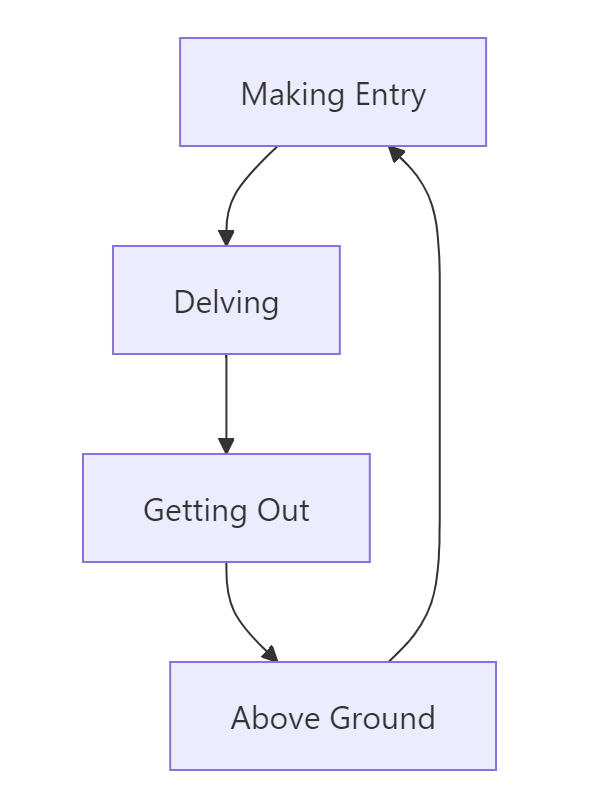
In our first session, we handled Character Generation, Making Entry, and a short stretch of Delving, two of the game’s four phases. The following session wrapped up Delving and carried us through Getting Out and Above Ground, completing the loop.
Character Generation
Character creation follows a familiar Carved from Brindlewood cadence, but with a clear nod toward OSR priorities. Starting position matters. The world is dangerous. The dungeon will change you.
After naming and describing their adventurer, each player allocates 3 points among their attributes. From there, they choose a starting location, the place that set their baseline expectations about safety, community, and scale.
For example:
Harjet’s Ford
Description: A backwoods village on the northern frontier, Harjet’s Ford is a gathering place for trappers, hunters, and peddlers. Blustery winds drive lashing rain across the cabins and sod huts clustered around a muddy trading common.
Character Question: What memory of Harjet’s Ford is the measuring stick by which you judge other communities as bigger and better than your home?
Move - Hedge Magik: Once per Delving phase, you may use a minor magik to gain Advantage on any roll except Unlocking. You must describe the magik you use.
Players read the location aloud and answer the question. This is not backstory for its own sake. The question establishes contrast. When the party later encounters cities, enclaves, or underworld communities, the table already knows what “big,” “safe,” or “civilized” means to this character, and how those assumptions might be wrong.
Next, each player chooses a travel location, a place they passed through on the way to the ruins of Ahknoor. This is not where they are from. It is where they learned something expensive.
For example:
The Necropolis at Okchit
Description: A deserted mesa topped with mausoleums, ossuaries, and crypts from civilizations across the world and across deep time. The honored and the infamous are entombed here together. Riches and secrets lie among the dead, guarded by traps and by things that remember being alive.
Character Question: What tales led you here, and why will you never return?
Move - Whispers of the Dead: Once per Delving phase, a spirit whispers a truth to you. If you make and describe an appropriate sacrifice, treat your next roll, other than Unlocking, as a 12+.
Again, players read the description aloud and answer the question. The reason for this question is risk calibration. Everyone at the table now knows what this character considers too dangerous, too costly, or not worth the price. That line will get tested.
After each player answers, the Keeper and the other players collaboratively name one item in that character’s Pack. Each Pack item can grant Advantage on a single roll.
More importantly, Pack items are an abstraction of the party’s carried resources. We are not tracking individual torches, arrows, or rations. Instead, as Pack items are marked off or exhausted, the Adventurers know that supplies are running low, luck is thinning, and it is time to think seriously about getting back to the surface. The Pack gives the table a shared, fiction-first signal for mounting pressure without turning the game into an accounting exercise.
Why This Structure Works (So Far)
On the surface, this is a light framework. In practice, it does several very OSR-friendly things:
- It establishes a baseline world before the dungeon distorts it.
- It teaches players what kinds of risks the game cares about through play.
- It gives the Keeper concrete material to threaten, twist, and call back to later.
By the time we entered Delving, every adventurer already had something to compare the dungeon against, and something they were quietly hoping not to lose.
I’m pleased with how quickly this produced playable, motivated characters without locking them into fixed arcs or elaborate backstories.
If you are a referee or designer reading this, does this feel like a useful way to front-load tone and stakes? Is it something you would want to steal, adapt, or stress-test at your own table?

